Beating the AI Impostor Syndrome: Embracing the Future of Work
Note: This article was written by a human, but it was supported by AI tools to enhance the writing process. The insights and perspectives shared here are based on my personal experiences and reflections on the topic of AI impostor syndrome.
Introduction
One of the psychological concepts with the greatest impact on my professional career has been the so-called “Impostor Syndrome.” In summary, it is a mental process that creates the false sense of being underqualified for most of your tasks, with the looming fear that someone will eventually notice it.
This syndrome has been widely studied and documented, and it has strong ties to multiple cognitive biases, especially those related to our self-perception of skills. We tend to view what we already know as trivial compared to what we don’t, and this gap generates the false impression that we are less capable than those around us.
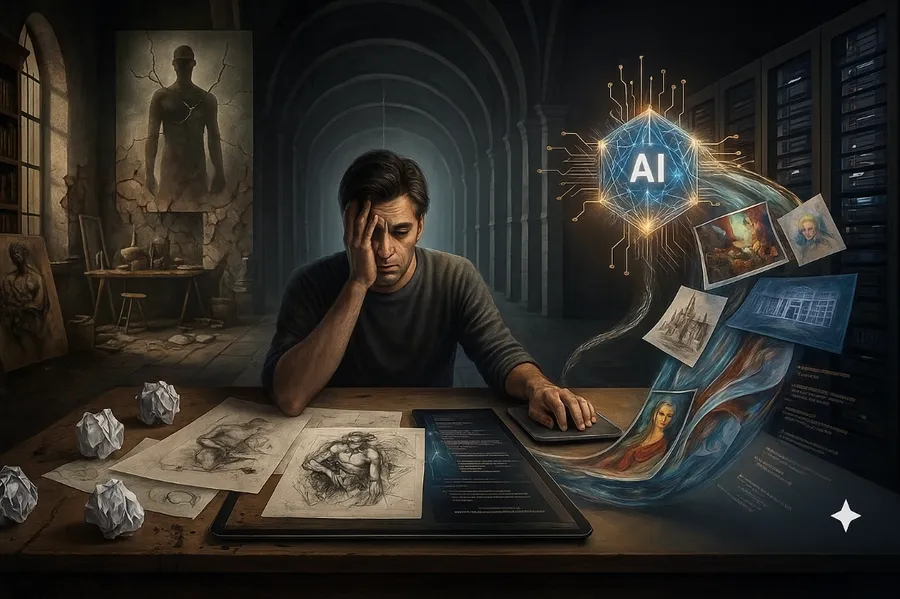
In recent months, with the rise of AI, I have been observing an interesting and amplified version of this syndrome: what I have decided to call the AI Impostor Syndrome.
What is AI Impostor Syndrome?
While the standard Impostor Syndrome has multiple root causes directly tied to other human beings, early conditioning, high-pressure work environments, social comparison, visibility, and so on, the AI Impostor Syndrome is a battle started by a machine and lost by a person.
There was a moment, in the race to adopt AI tools, when we crossed a line: we started by chatting with an AI, then brought it in as a copilot for our daily tasks, and finally allowed it to become capable of doing things in our place.
This last step was pivotal in the rise of AI Impostor Syndrome, as we now face the uncomfortable reality of competing against a system that holds more knowledge about the technologies we work with and can retrieve that information far faster than we can.
In that scenario, particularly in fields that are heavily knowledge-driven, we are playing a rigged game against our own minds.
The Rise of AI in the Workplace
Once AI landed, it was inevitable that knowledge-based professions would adopt and integrate it into their daily routines. It is a powerful tool that accelerates many processes in ways that would have been completely unimaginable five years ago. The benefits are real, tangible, and obvious, and many people have crossed an important knowledge barrier to acquire skills (or perhaps more accurately, to access them) that were previously out of reach.
But, at what cost?
The first and most evident one is the workforce cost. The knowledge economy has operated, since the days of craftsmanship, in a very specific way: new professionals started from the very basics, guided by more senior and experienced colleagues, gradually acquiring the knowledge and expertise needed to perform their work properly.
That system worked, especially in knowledge-based roles. But it has now been fundamentally disrupted by the AI factor.
Today, companies do not need as many junior positions as before. An AI agent can handle the same work, often better in specific areas, and at a fraction of the cost. Meanwhile, senior professionals no longer need to invest time training people who might eventually leave the organization. A win-win for the company, right? Until that senior layer retires in ten to fifteen years, and you can only hope that AI will have reached the same depth of expertise built on the knowledge accumulated today.
Somewhat risky, from my point of view, but that hasn’t stopped thousands of self-proclaimed gurus from announcing that the AIpocalypse has finally arrived.
There is, however, a second and less visible cost that comes with the rise of AI: the mental toll on existing workers. And AI Impostor Syndrome is one of its most significant consequences.
The Psychological Impact on Professionals
The psychological burden of working alongside AI operates on two distinct levels, and understanding both is essential to addressing the syndrome effectively.
The first is cognitive overload through verification. When an AI produces an output: a block of code, a written analysis, a system architecture, the human in the loop cannot simply accept it. They must review it, validate it, and ultimately own it. This creates a paradox: the tool that was supposed to reduce mental effort actually increases it in a specific and exhausting way. You are no longer the author; you are the auditor. And auditing work you didn’t fully produce, in domains where your confidence is already fragile, is a uniquely draining experience.
The second level is identity erosion. Knowledge workers build their professional identity around what they know and what they can do. When an AI can produce in seconds what used to take hours of accumulated experience, the implicit question surfaces: what exactly is my value here? This is not a rational fear, it is a deeply emotional one. And like all emotional responses to perceived threat, it does not respond well to logical reassurance alone.
These two mechanisms, cognitive overload and identity erosion, feed each other. The more you rely on AI to produce, the less you exercise your own judgment. The less you exercise your judgment, the less confident you feel. And the less confident you feel, the more you lean on AI. It is a loop, and recognising it as one is the first step toward breaking it.
Strategies for Overcoming AI Impostor Syndrome
Embracing Continuous Learning - Vibe Learning vs Vibe Coding
Over the past few weeks, I have been running an experiment on myself. Feeling the mental strain of AI Impostor Syndrome, I made a conscious decision to step back from vibe coding, fully delegating the coding process to an AI agent, and embrace what I now call vibe learning.
I was using OpenCode connected to different models, and I switched from the build mode to plan mode. This means that OpenCode retains all the context but does not implement any changes: it only provides information about them. This allowed me to slow down the process, fully understand the steps involved and, crucially for me at this stage, be the one actually applying the changes.
The difference was not just practical, it was psychological. When I was the one typing the changes, even if every single decision had been explained to me by the AI moments before, I was rebuilding a sense of authorship over my own work. The AI became a teacher rather than a contractor.
This distinction matters more than it might seem. Vibe coding optimises for output. Vibe learning optimises for understanding. Both are legitimate depending on the context: there are absolutely scenarios where shipping fast is the correct call. But when the goal is to preserve and deepen your expertise, the mode you choose is not a technical detail. It is a statement about the kind of professional you intend to remain.
A simple heuristic I’ve started applying: before delegating a task entirely to AI, ask yourself whether you could explain the result to a colleague afterwards. If the honest answer is no, that is a signal worth paying attention to.
This shift has played a key role in significantly reducing the recurring intrusive thoughts and unsettling emotions that surfaced when the AI was the sole driver of implementation.
Accepting AI as a Tool, Not a Threat
Let me be clear: I am not against AI in any way. I believe it represents a enormous leap forward for humanity, and it will allow us to reach further and faster than we ever thought possible. However, every disruptive technological shift, and especially one of this magnitude, comes with drawbacks and dangers that must be properly addressed.
The easy path is to surrender to the current tide and accept AI as a new abstraction layer, one that frees us to focus exclusively on the creative dimension of any knowledge-driven process. I, however, count myself among the resistance. I believe the defining element of a knowledge-based career is, precisely, the knowledge itself. I consider it the cornerstone of my entire professional path, and that is why I cannot accept the idea of letting it go, or resigning myself to losing control over it.
There is, therefore, an alternative way of thinking about AI: not as a substitute for human beings, but as a force multiplier for our skills and capabilities. AI is, in short, the ideal tool to amplify our endeavours and take us to places we never imagined we could reach.
Writing Your Own Narrative in the Age of AI
For that reason, it is important to reframe the way we talk about it. Tune out the doomsayer gurus who spend their days predicting the end of the world as we know it, and instead focus on everything we can achieve through its thoughtful use.
This new narrative will have a profound impact on how we experience the uncertainty that AI brings, empowering us to place ourselves at the centre of this disruptive change. To be the pilots of the ship, with AI as the indispensable co-pilot: the ideal companion on this journey.
Conclusion
AI Impostor Syndrome is not a sign of weakness. It is, in many ways, a sign of intellectual honesty: an acknowledgement that something significant is happening and that the old rules no longer fully apply. The professionals who feel it most acutely are often precisely those who care most about the quality and integrity of their work.
The answer is not to suppress that discomfort, nor to surrender to it. It is to use it as a compass. Let it point you toward the parts of your craft that still need your full attention. Let it remind you that understanding is not a luxury, it is the foundation that makes everything else possible.
The goal is not to keep up with AI. The goal is to remain, genuinely and irreplaceably, the person who knows what to do with it.